
The Maintainers has spent nearly a decade asking an essential question: What does it take to keep our world going, not just technologically, but socially, ecologically, and ethically? Since 2016, The Maintainers has evolved from a scholarly provocation into a living, breathing network of practitioners, researchers, organizers, and artists who are united not by a single discipline or goal, but by a shared commitment to care, repair, and collective upkeep.
Over the years, the project has taken on many shapes ranging from national conferences to thematic working groups and practitioner-led fellowships. Each shape reflects a different way of sustaining community, distributing power, and evolving in response to context and capacity. Throughout, The Maintainers embraced intentional transitions, interdisciplinary thought, distributed leadership, and a deep respect for the knowledge that emerges from the margins: whether geographic, disciplinary, or institutional.
This document offers a narrative map of these distinct eras, not to present a perfect model, but to offer strategic lessons and honest reflections for others navigating complex transitions. Whether you’re building a knowledge commons, stewarding a distributed network, or simply trying to care for what matters in your own corner of the world, The Maintainers’ story thus far may help illuminate ways of considering future formations of a project with intentionality and care
1. The Conference Era (2016–2019): Convening around a Concept
The Maintainers began as a bold academic provocation to stop fetishizing innovation and instead center the people, systems, and infrastructures that keep our world going. Led by three Co-Directors, the project quickly resonated with scholars across science and technology studies (STS), information science, history, and urban planning. With support from the Alfred P. Sloan Foundation and hosted by academic institutions, The Maintainers convened three national conferences that explored maintenance through interdisciplinary tracks (software, transportation, infrastructure) and reframed upkeep and repair as essential, undervalued labor. These events built cross-field trust, sparked theory-building, and challenged the cultural dominance of the “innovation delusion”, i.e., the belief that progress stems solely from disruptive breakthroughs, while overlooking the essential, sustaining work of maintenance, care, and upkeep that underpins modern life.
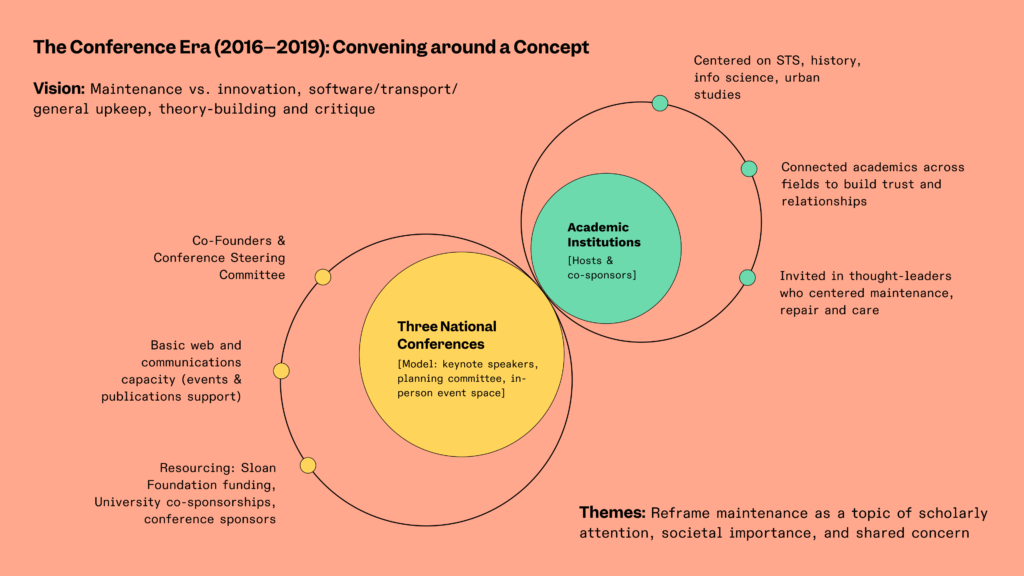
Yet this phase also revealed the limits of a purely academic model. While the conferences created fertile ground for conversation and critique, the framing remained largely abstract, limiting accessibility for the very practitioners whose work inspired the movement. Early infrastructure was modest (basic web and communications support) but the project gained traction and visibility. This era planted the seeds for what would come next: expanding beyond critique into community, and beyond scholarship into practice.
2. The Maintenance Communities Era (2019–2022): From Ideas to Infrastructure
As The Maintainers transitioned out of its conference roots, it began reshaping itself into a more structured network with central staff, sustained programming, and emerging communities of practice. Funding from the Sloan and Siegel Foundations enabled increased staff time for program design, virtual convenings, and documentation. One standout success of this phase was the Information Maintainers, an autonomous yet supported group that hosted public events and produced timely, critical reflections on digital preservation and knowledge systems. This phase also saw the development of The Maintenance Community Framework (MCF), a strategic tool to support values-aligned, sustainable network growth.
Instead of continuing with in-person gatherings, the team made a deliberate decision, accelerated by the COVID-19 pandemic and a desire to connect people grounded in different places, to invest in a solid, fully virtual infrastructure. This included creating virtual convenings where place-based practitioners could exchange strategies, models, and frameworks. Staff and collaborators brought experience in education, community organizing, and network stewardship, which shaped a new programming arc centered on care frameworks, interdisciplinary exchange, and bridging silos between practitioners. The team redesigned the website, strengthened virtual engagement tools, launched The Maintainers Newsletter to share original content and member updates, and hired communications and engagement consultants. These investments enabled the project to weather the disruptions of the pandemic while reaching far beyond academic and policy circles.
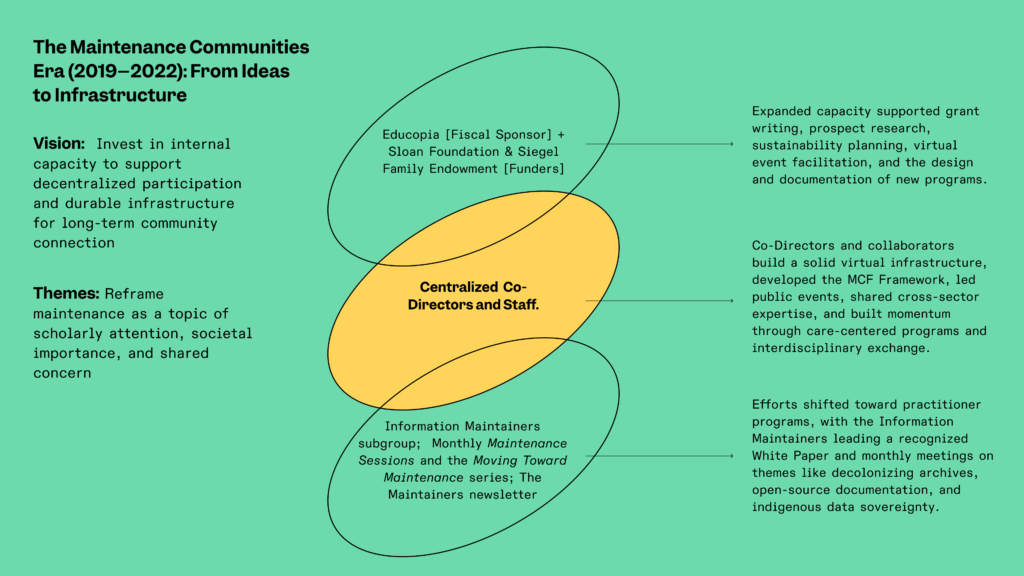
Still, the shift revealed ongoing tensions: the mission was compelling but remained abstract to many outside academic or policy circles. High-effort events strained limited capacity, and even with new staff bringing deep community experience, it was challenging to engage practitioners overwhelmed by pandemic pressures. The Maintainers proved its staying power by building a durable virtual presence, experimenting with new formats, and laying the groundwork for more accessible, practitioner-centered approaches to come.
3. The Fellowship Era (2020–2025): Field-building with Practitioners
During the Fellowship Era, The Maintainers shifted from a centralized convening model to a distributed framework that centered the leadership of on-the-ground practitioners. Fellows (community organizers, educators, artists, and repair professionals) defined and led thematic programs rooted in place-based knowledge and cross-sector dialogue. With continued support from funders including Siegel Family Endowment, the Alfred P. Sloan Foundation, ALICE, and VR (Ex) Change, the network prioritized compensated labor, interdisciplinary matchmaking, and community-building across fields. Fellows hosted public events, contributed original research, shaped the network’s communications (including launching a steady social media presence) and steered programming like the “Moving Toward Maintenance” series and monthly Maintenance Sessions. Together, they explored topics such as degrowth, indigenous knowledge, repair education, and solidarity with essential labor, anchoring the theory of maintenance in everyday practice.
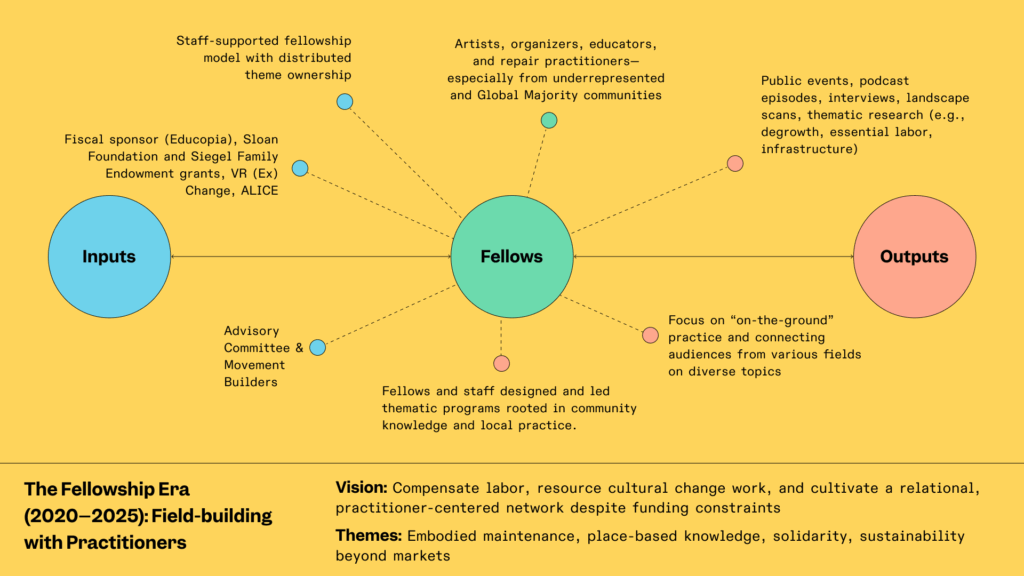
As the model evolved, The Maintainers deepened its structure through the Movement Builders cohort and its first Steering Committee, composed largely of past fellows. Staff expanded program design and documentation while navigating the difficulty of resourcing anti-market work through traditional philanthropic systems. Though several proposals to fund a large-scale model went unfunded, the network leaned into a smaller, relationship-centered approach. Fellows’ leadership helped define what it meant to do this work outside of academia, connect across disciplines, and frame relevant policy questions. The Fellowship Era demonstrated that meaningful impact was more viable through depth than scale, and that the people most impacted by maintenance challenges must be central in shaping both the content and the container of the work. Rather than create a revolving door of fellows that changed every year and disappeared, The Maintainers sought to provide the option of continued engagement beyond the fellowship term, offering options of deeper involvement for all those fellows with capacity to do so.
4. Exit to Network (2024–2025): From a Grant-funded Initiative to a Lightweight, Peer-led Network
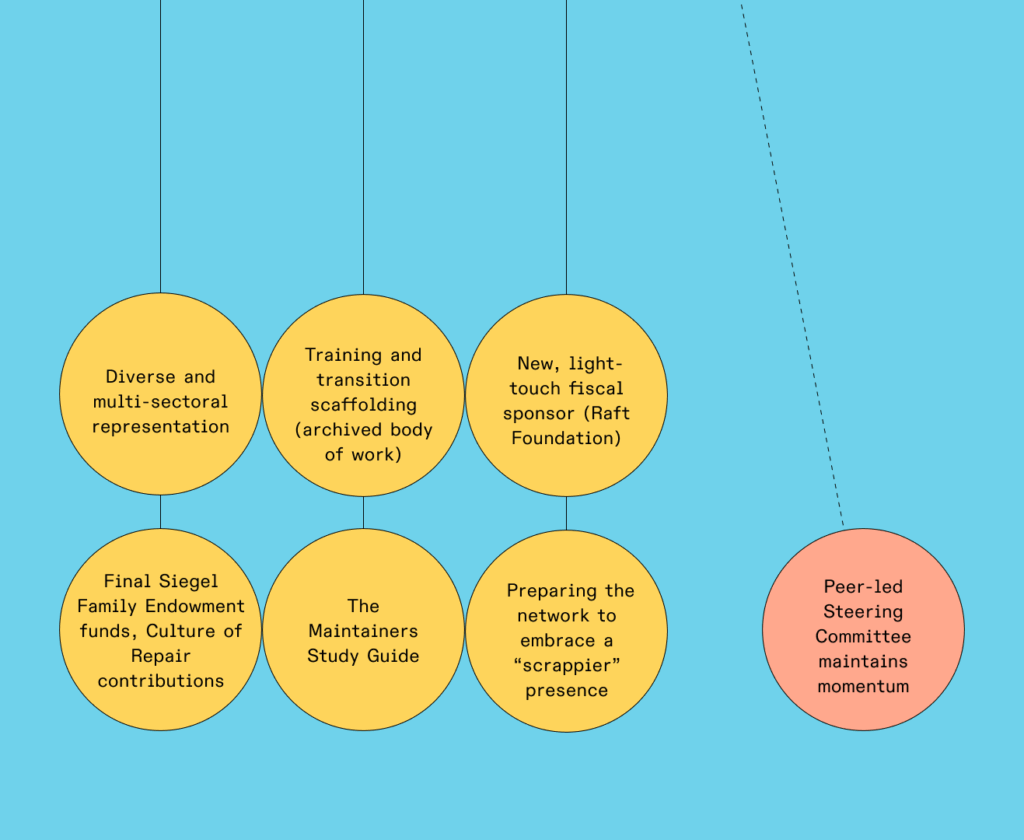
In this phase of evolution, The Maintainers focuses on handing off infrastructure, building governance capacity, and safeguarding its body of work. Fiscal sponsorship moves from Educopia to the Raft Foundation. Full-time staff roll off while preparing the new Steering Committee to take the reins—with training, documentation, and workflows designed to support a “low-hum” model of sustainability. Residual funds from The Maintainers’ earned revenue campaigns (via their Substack newsletter and a contribution from The Culture of Repair Project) will help resource this transition, enabling small, compensated roles for community members such as blog authors and event facilitators.
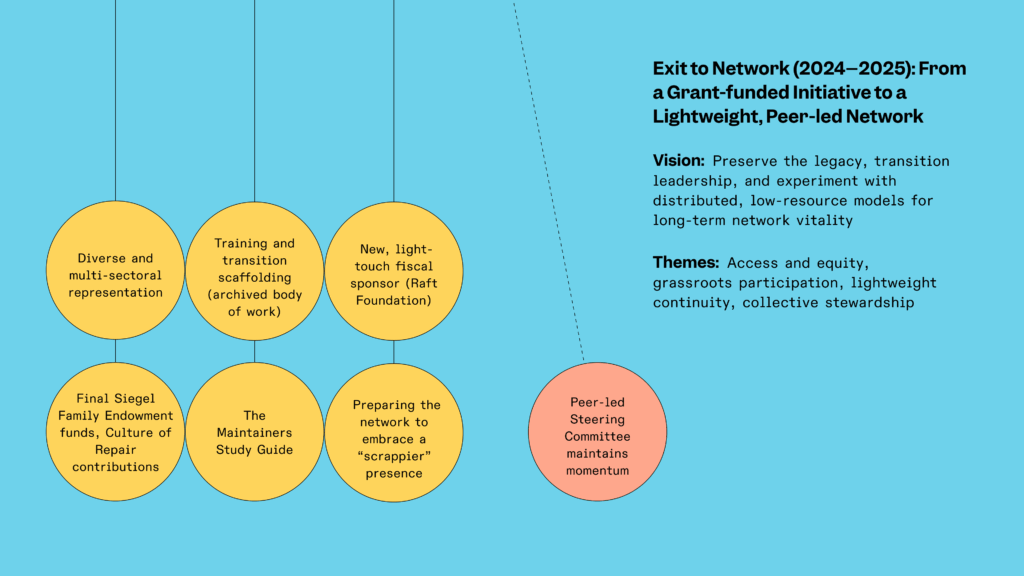
Virtual Meet Ups become the network’s connective tissue, spotlighting practitioners from Uganda, the Netherlands, India, Spain, Colombia, and the U.S. The network embraces a more grassroots presence while reactivating its convening spirit, partnering with groups like Fixit Clinics, Koneta Hub, 60 Hertz Energy, and the Nanny Solidarity Network. The Maintainers continue to participate in design sprints, university events, and global conversations about care, equity, and repair. Infrastructure is set up to preserve and share the project’s work over time, including the archiving of the website to OSF and the publication of The Maintainers Study Guide. Even amid funding uncertainty and a decentralized structure, the network sustains momentum by rooting in values of access, practitioner leadership, and collective stewardship.
Key Takeaways from The Maintainers’ Evolution:
- Network shapes shifted over time1: The Maintainers demonstrated that maintenance is not just a topic of study, but a way of organizing while centering care, cooperation, and long-term thinking. Though the network evolved through distinct phases, it has consistently shown that maintenance is not just a topic, but a method and ethic for working together in uncertain times.
- Distributed leadership, not just participation2: Leadership was shared across staff, fellows, and community members—supported by structures like advisory committees, thematic cohorts, and relational infrastructure. Paid fellowships allowed educators, artists, and repair workers to shape themes, lead programs, and root theory in practice.
- Programming fostered interdisciplinary dialogue3: Events like Networking Meetups and the Moving Toward Maintenance series broke down silos and brought together perspectives from public health, engineering, decarbonization, and indigenous knowledge. These gatherings made visible the shared values and struggles across disciplines, revealing maintenance as a unifying lens for justice, sustainability, and care.
- Resourcing work that could potentially be “anti-market” was challenging: Work aligned with degrowth, care, and repair often ran counter to funder priorities and traditional metrics of impact, revealing limits in philanthropy’s ability to sustain values-aligned models.
- Relationships > Scale: Rather than chase rapid growth, The Maintainers invested in trust-building, place-based knowledge, and slow, steady organizing, showing that smaller, deeply relational networks can be powerful and enduring.
- Transitions were intentional and transparent45: The network embraced change openly, documenting learnings and modeling how infrastructure can be gracefully transformed, not just built or maintained.
- How to Build More Resilient Networks: Social impact networks inevitably face moments of existential crisis. But networks can prepare for them by asking the right questions. Michelle Shumate & Katherine R. Cooper Fall 2022 https://ssir.org/articles/entry/how_to_build_more_resilient_networks ↩︎
- Five Steps to Building an Effective Impact Network: How network entrepreneurs can catalyze large-scale social impact through a process that applies to networks across all systems and sectors. David Ehrlichman, David Sawyer, & Jane Wei-Skillern Nov. 11, 2015 https://ssir.org/articles/entry/five_steps_to_building_an_effective_impact_network#
↩︎ - Learn Before You Leap: The Catalytic Power of a Learning Network. David Ehrlichman & David Sawyer Jul. 27, 2018 https://ssir.org/articles/entry/learn_before_you_leap_the_catalytic_power_of_a_learning_network
↩︎ - Navigating Purpose and Collaboration in Social Impact Networks. Dylan Skybrook Sep. 10, 2018 https://ssir.org/articles/entry/navigating_purpose_and_collaboration_in_social_impact_networks
↩︎ - Networks for Good Works. Joel M. Podolny. Winter 2007. https://ssir.org/articles/entry/networks_for_good_works#
↩︎