
Madison Snider is a Research Fellow at Siegel Family Endowment, a grantmaking organization that aims to understand and shape the impact of technology on society. Madison received her PhD in Communication from the University of Washington. Her research intersects science and technology studies, labor studies, and critical infrastructure studies. In her role, she works to build bridges and cultivate collaboration among those interested in building just physical, social, and digital infrastructures.
01. Can you describe the system you’re working in and trying to change, including its main functions, the patterns you notice, and the outside forces that affect it?
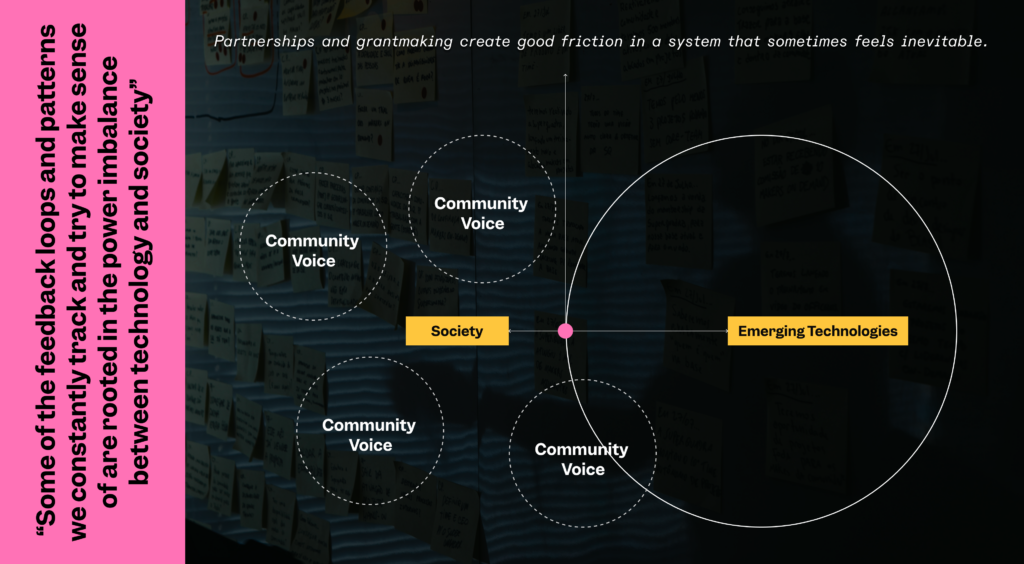
The system I’m engaged with is really a system of systems, but it largely falls into the dynamic between technology and society. My work focuses on illuminating opportunities to bring community voices into the design, development, and deployment of emerging technologies. Some of the feedback loops and patterns we constantly track and try to make sense of are rooted in the power imbalance between technology and society, which often feels like a David and Goliath situation. At the same time, each small community of engaged and activated people that we work with—through partnerships, grantmaking, and beyond—creates friction within a system that otherwise does a very good job of convincing us of its inevitability. So the system we’re working within is really about identifying those moments of friction and the possibilities they create.
I’m trained as a qualitative social scientist and use ethnographic methods to answer research questions—that sensibility continues to shape my work. Deep, active listening is critical to identifying patterns and feedback loops in complex systems. I also approach it with a theoretical foundation: these are complex systems that don’t respond in predictable, cause-and-effect ways. They’re adaptive, they resist stasis, and they’re often best understood in those moments of friction I mentioned earlier, when values that may appear aligned begin to splinter or come into tension. Those are the moments where we can learn the most.
Let me ground this with an example from my research. My dissertation focused on the implementation of network devices—the Internet of Things—using sensors embedded in the built environment of a university campus. These are often part of “smart campus” initiatives, and you see similar projects in “smart city” contexts. I was interested in how technological change would impact care and maintenance workers responsible for keeping the physical infrastructure of the campus safe, secure, and functional. I gathered data from custodians, window washers, facilities workers, and others in that category.
What I found was that the failure to integrate the expertise and needs of these workers into the design, development, and deployment of these tools (and this increasingly networked infrastructure) not only made it harder for them to do their jobs safely and well, but also undermined the broader goals of the systems themselves. Whether the intended outcomes were energy efficiency, improved safety, or overall functionality, those goals failed when the workers’ knowledge was excluded.
I characterize this as a design values failure, and it strongly echoes through my current work at Siegel. We’re interested in shaping and understanding the impact of technology on society more broadly. The takeaway is that when emergent technologies are introduced, if you don’t meaningfully map the value orientations that different community members bring to the infrastructure they rely on, whether social, physical, or digital, you risk disregarding the inevitable values tensions that come with innovation and integration.
Ignoring those tensions tends to uphold the status quo, where decisions made by the powerful few often harm the broader public. More importantly, we miss the opportunity to build something better—even if it’s slower, even if it resists “disruption for disruption’s sake”—in favor of approaches grounded in care, maintenance, and improving what already works.
02. Shifting to your day-to-day work as a research manager at Siegel, what is the nature of the work you do? What is the relational infrastructure of that work? How do you, in your role with the Endowment, build relationships with communities that are mutual and non-extractive? Finally, how do you make the system you’re working in visible to all the people who are either implicated in it or critical to its change?
I currently work with an amazing group of researchers who are multidisciplinary, transdisciplinary, even anti-disciplinary, and they work across very different organizational settings. They include scientists, policy analysts, and artists—people asking critical questions and designing interventions to build a more just technological future.
I’ve often said that my favorite part of my job is bringing together people who might not otherwise be in the same room and getting them to talk. Many of these scholars are based in academia, think tanks, or nonprofits, where they are rightly focused on narrower sets of questions or implementation challenges. A good example of how we address this is through monthly gatherings, where fellows share their work and workshop early questions they’re grappling with. Sometimes the result is blank stares, but more often it sparks challenging, generative conversations.
The last few months have been difficult. I work primarily with emerging, early-career interdisciplinary researchers based in the U.S., and the federal divestment from research institutions, along with political attacks on individual researchers, poses an existential threat to their ability to continue this work. Funding is one issue, but I’m especially focused on the chilling effect of anti-science and anti-DEI attacks, particularly those originating in Washington, D.C. These reinforce the status quo, and when the dust settles, it’s interdisciplinary, socially engaged, and humanistic researchers—the ones who don’t fit neatly into categories—who will bear the brunt of these pressures for a generation. That can be deeply discouraging.
And yet, I have the privilege of working closely with these scholars. Reflecting on this past year, the best moment for me was gathering about 15 fellows in March at Cornell Tech’s campus on Roosevelt Island in New York. Despite the polycrisis swirling outside the doors, this group was driven by their questions. They were undeterred by what the loudest voices were saying about the value of their work. They simply don’t have time to stop. That gave me an immense amount of hope, which I still carry.
To connect this to systems leadership: for me, it’s about surrounding yourself with people like these, and then becoming one of them. Systems leadership is grounded in leading with questions, not assumptions. It’s about working with care and urgency, but not haste. These fellows embody that. They don’t back down from important questions even when told to. That gives me tremendous hope.
Across all portfolios at Siegel, we are thinking about how co-design, design alongside community, can be prioritized at all levels of systems and technological development.At the March gathering, I asked the fellows to think about possible futures through different areas of inquiry—one was community-led design of digital infrastructure. At that convening, we had civil society leaders, policy experts, privacy advocates, and community governance researchers. Some fellows immediately saw themselves as part of that infrastructure; others weren’t sure why they were at that table. My role is not to force-fit them, but to challenge them to define the problem or opportunity in ways that help them see their place in it.
03. How do you measure or evaluate whether the efforts you’re orchestrating are really advancing system change? How do you determine meaningful measures of impact and success? What data or signals do you look at?
This is where our philosophy of grantmaking and grantee partnership comes into play. As a social scientist, I’m used to detailing my methods, creating metrics that are legible across my field, and making findings visible in a rigorous way. The challenge and the opportunity at Siegel is shifting that toward a more relational way of understanding impact and success in partnership with grantees.
To be explicit: at Siegel, we base the measurement of our grants and partnerships on a shared learning question. That question becomes the foundation of the relationship. From there, we co-design a shared hypothesis with our partners, one that advances mutual learning and enables their work to ladder up to the broader question being explored across the portfolio alongside peer organizations.. This applies across our areas of interest, whether infrastructure, workforce, or learning.
This approach reflects our philosophy of inquiry-driven grantmaking: posing clear questions, interrogating them systematically, and applying what we learn to the next round of inquiry. We draw on the emerging science of questions, advanced by our partners at Data4Philanthropy and others, not to fixate on definitive answers, but to sharpen the questions we ask with rigor, care, and diverse perspectives. Grounding our work in questions and hypotheses allows for a more adaptive, relational form of assessment, more attuned to qualitative insight and the expertise of the communities we partner with. We believe this approach better reflects the complexity of the systems we seek to influence.
This allows us to get very specific with individual grants while also zooming out to broader strategic questions: Are our current partners aligned with these questions? If so, how? If not, why not? Where are gaps that require new partnerships to challenge us and move closer to answers? For me and our team, it’s less about our own expertise and more about forming the right questions, learning from our partners, and translating those learnings into actionable insight.
To support this work we’ve recently stood up a Knowledge and Impact team that works across our research and grants teams to distill and translate learnings, so the organization can make sense of them at the level of these strategic questions.
04. What feels important to you about systems-engaged leadership practice in moments like the ones we’re living through right now?
I think so much of systems leadership theory resonates with what my team has naturally, and sometimes purposefully, done: we’ve pulled together folks who may not define themselves as systems leaders, but certainly are practicing it. The big takeaway for me is that leadership needs to be plural.
There’s already leadership among our partners, among my team, and within the broader communities we seek to impact. Systems leadership, to me, is about identifying and organizing a plurality of leaders rather than centering one person’s vision.
In the context of the tech-and-society system we work in, this approach feels new and even antithetical to the Silicon Valley model of the singular genius hero—someone whose vision we follow blindly, conveniently ignoring the ways power and wealth are hoarded. What we’re doing is quite different. Someone once described our work as being less Chris Farley and more Lorne Michaels, which I initially thought was a wild comparison—but I understood the point. It’s not about being in the spotlight; it’s about thoughtfully aiming the spotlight, assembling the right people, and, most importantly, creating space for possibilities that no single person could have imagined on their own. Systems leadership often involves stewarding the work, centering others, and giving credit where it’s due. That part really resonates with me and is something I see reflected in the way my team leads.
05. Given your engagement with the framework, does it resonate with you? If so, why or why not? And what other macro frameworks do you draw from when conceptualizing and operationalizing the change work you’re doing?
Yes, I found it really useful and resonant, with the caveat that frameworks are always just that: tools. They’re neat and helpful, but they’re not absolute. I especially appreciated that this framework isn’t linear. Any model that adheres too rigidly to linearity isn’t particularly useful when thinking about systems leadership. One challenge I’ve found, and this is true of complex systems in general, is integrating multiple frameworks simultaneously to challenge assumptions that might arise from relying on just one.
Lately, my colleague Evan Trout, a grantmaking manager at Siegel, and I have been diving deeper into our infrastructure work, which is inherently multidimensional, as social, physical, and digital all at once, and its specific through-lines with community. This multidimensional view existed before I joined Siegel and was part of what drew me to the organization. , Specifically, we have been working on identifying opportunities to create platforms, digital or otherwise, that are responsive to community needs, without being constrained by the scale-focused models common in big tech or Silicon Valley. We’re conceptualizing three aspects of this work: stewardship, platform design, and governance.
So, to answer your question, I find existing frameworks valuable insofar as they can serve as stepping stones to create new ones. We use them, encounter their limitations, and then build something tailored to our context. If frameworks remain static, they fail to do what they’re meant to do, which is to help us navigate complexity and guide action.
06. Write a love letter to the future. What advice would you give to emerging leaders who want to drive systemic change in their fields? Are there particular skills that, if everyone had them, would fundamentally shift our ability to create a more just future?
I love this question. It ties into what I was saying about the fellows: there is a passion for the work that cannot and will not be stopped by serious structural challenges, whether in funding or in attempts to silence dissent. You only need to look at people speaking truth to power to find hope, and I see that hope in the fellows.
Right now, part of the work is creating spaces, shining the spotlight thoughtfully, and using the relative power we have as an endowment responsibly, to lead with questions and support risk-taking endeavors. Extra-institutional efforts are also critical: protecting institutions under attack, supporting them through grantmaking, and evidencing the need through research. There’s amazing work happening outside traditional institutions, and part of our role is building bridges, linking learning happening at smaller or alternative scales with institutional capacity. For example, if a community needs to organize against a data center threatening their water resources, are existing institutions responsive to that need? Often, hybrid solutions combining institutional and extra-institutional innovation are required.
More broadly, my advice to emerging leaders is to remain a student. I’ve been a student for a long time, and I joke that it’s the one thing I’m good at, but there’s truth in that. The challenge is translating a learning mindset into meaningful action. I’ve been fortunate to find a team at Siegel Family Endowment that shares this “forever student” approach, and to work with grantee partners who do as well. If your environment doesn’t naturally support this, find allies within or beyond your organization.
Grounding leadership in community wisdom means operating as a student of the community: setting aside assumptions, engaging in deep listening, and recognizing that this takes time and resources. That’s a privilege I have working for an endowment, and it’s also a responsibility to extend that privilege to partners in different circumstances.