
![Systems Leadership Series: Kimberly Jenkins [The Fashion and Race Database] talks to Jessica Meyerson [Educopia] about exploring fashion’s fault lines and confronting exclusion and erasure with creativity and courage](https://educopia.org/wp-content/uploads/2025/07/Instagram-post-2-1024x1024.png)
Educopia’s second interview in its Systems Leadership Series is with Kimberly Jenkins. Based in New York with a background in cultural anthropology, art history and fashion studies, Kimberly M. Jenkins is the Founder, Director and Principal Researcher of The Fashion and Race Database, a one-of-a kind learning platform about fashion and race, as well as the consultancy Artis Solomon, which provides bespoke research and insight about fashion history and theory.
How do you draw a circle around the system you’re in and trying to change? How do you define its key parts, dynamics, and boundaries?
One important term we use in fashion studies is the fashion system, rather than the fashion industry. While the fashion industry typically refers to the business side (marketers, publishers, models, designers, executives) the fashion system includes that, but also educators (from high school to higher ed), museums and curators who conserve, nurture, and interpret fashion, and consumers, whose habits and attitudes shape the system itself.
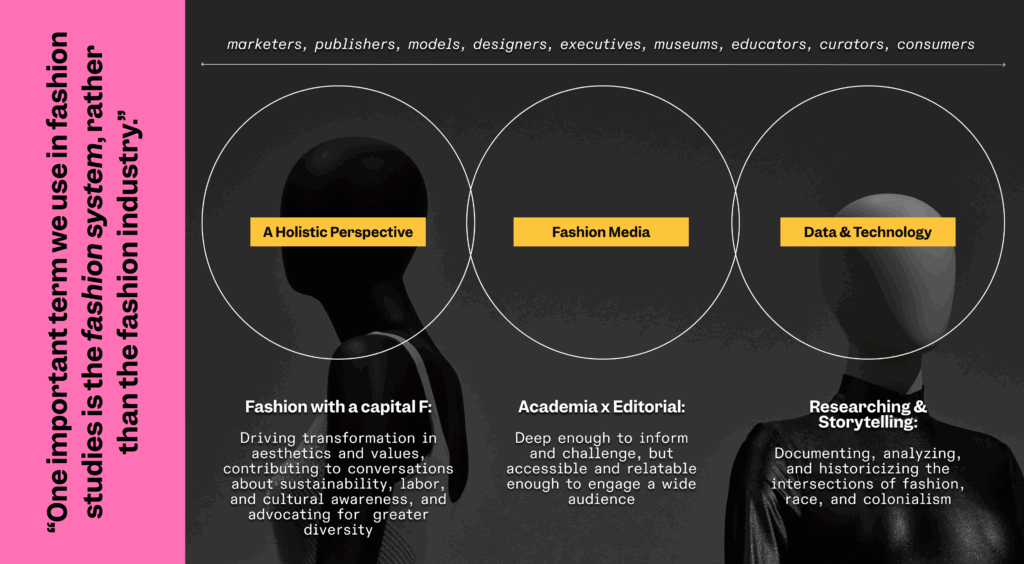
With The Fashion and Race Database, and as a fashion studies scholar, I look at fashion holistically: fashion with a capital F. We’re not just examining the industry; we’re driving transformation in aesthetics and values, particularly around beauty and luxury. We question the history and meaning of luxury, contribute to conversations about sustainability, labor, and cultural awareness, and advocate for a greater diversity of minds in fashion and positions of leadership.
Another key area is fashion media. The Fashion and Race Database offers a new approach to publishing, one that is a hybrid between academia and editorial. It’s not quite a fashion magazine, but also not as inaccessible as a scholarly journal. It’s deep enough to inform and challenge, but accessible and relatable enough to engage a wide audience. We aim to bridge academia, industry, and everyday life.
How do you understand the relationships and feedback loops between different parts of the fashion system—like data aggregators, producers, suppliers, and consumers—and how do those interactions shape the system as a whole?
In terms of data and how it connects across the fashion system, we’re not fully siloed, but different parts of the system use data in very different ways.
In the industry, data supports key segments like trend forecasting and revenue analysis. If you look at publications like The Business of Fashion, they often use a kind of “playbook” language, talking about investments, bets, and the musical chairs of creative directors. It’s very transactional, almost like sitting at a poker table. There’s also trend analysis: what are we wearing and why? Are beauty standards shifting? Are people embracing luxury or leaning into minimalism and casualwear?
Then there’s marketing data like engagement metrics, click-through rates, social media performance. How are websites doing? Are people shopping in person or online? How online are they? All of this ties back into how trends form and circulate.
In design education, we’re seeing newer conversations emerge, particularly around sizing. Within the last decade, and especially in the last few years, some design schools have started adopting larger dress forms. This might seem like a small change, but it’s significant. For a long time, students were trained to design on mannequins that reflect only a narrow range of body types—typically size 8 or smaller—especially for theses and major projects.
On the cultural and historical side, where I come from, data looks different. It’s not “hard numbers”, it’s discourse, theory, and conceptual frameworks. After finishing my degree and building the Fashion and Race course and database, data for me became about piecing things together (books, articles, resources) that help analyze and support this larger framework around fashion and race.
The persistent issues we’ve seen in fashion: cultural appropriation, retail discrimination, dominant and exclusive beauty standards, lack of diverse leadership, environmental harm, hyperconsumption, and the influence of politics, are the same issues I began organizing over a decade ago, when I first developed the Fashion and Race syllabus as a course.
At first, I assumed visitors to the Fashion and Race Database would automatically connect the dots among these core issues. But in January 2024, I realized we needed to be more explicit, so I introduced monthly themes, inspired by the editorial rhythm of fashion magazines. Over 12 months, these themes unfold like a syllabus in motion: Dress and Structural Power in January; Fashion, Race, and Politics in February; The Construct of Fashion in March; Sustainability in April, and so on. Each month, we center our content and resource-gathering around that theme. We highlight relevant books, articles, thought leaders, and creative projects, essentially using the platform as a remote teaching tool.
Another way we track and share this information is through the “In the News” digest: a biweekly global roundup of headlines connecting fashion and race. It might include a breakthrough, like a designer of color being appointed to a major house, or a disturbing story about retail discrimination, cultural appropriation, environmental damage, or labor violations. We also produce Learning Guides tied to each monthly theme. We’ve been doing this long enough that if you read through our digests over the past few years, you can actually trace the evolution of the fashion system: where it’s moving, what issues persist, and what’s changing. Our goal is to synthesize what we’re observing and present it in a way that’s accessible, digestible, and rooted in pedagogy. That’s the heart of it: education is the agenda.
How are people and organizations working to advance equity and accountability in fashion adapting to fast-changing conditions like climate change, political upheaval, and economic volatility?
Long before the new administration, we were already seeing early warnings, economic and ideological. As early as fall 2024, we started getting emails from many of our key partners, like schools and museums, about departmental shakeups, budget cuts, and the elimination of key resources. I remember thinking, Oh no, it’s starting.
Around the same time, institutions began to go quiet on diversity, equity, and inclusion. People in my network, especially those working at the intersection of fashion and sustainability or environmental justice, started to lose funding. On social media and in direct emails, some shared that they’d lost jobs, contracts had ended, and they were being forced to pivot.
The people and organizations doing the best right now are the ones who’ve been doing the work for years, well before things came to a head in 2025. For example, in California, the garment workers’ union has been fighting for just labor conditions for a long time. Environmental justice groups, too, have seen periodic spikes in attention and support, usually when an issue dominates the headlines. But once the news cycle moves on, public concern fades, even though those groups never stopped doing the work.
I have friends in Food Studies and food justice whose work I’ve followed closely for years. Food and fashion are sister industries, both built off the backs of enslaved people, both shaped by extractive systems, and both deeply tied to culture. The food justice world has often felt a few steps ahead when it comes to labor advocacy, storytelling, and community-rooted strategies. They’ve long focused on who harvests and prepares our food, what that labor looks like, and the cultural meaning behind what ends up on our plates. One organization I’ve learned a lot from is the Food Issues Group (FIG), which is deeply embedded in mutual aid work. Watching how they navigate precarity – how they prioritize care, community, and cultural continuity – has given me a lot to think about as we face these challenges in fashion.
Adaptability has felt precarious. Equity leaders, especially in fashion, have been among the first hit. The institutions we’ve collaborated with, businesses, universities, even funders, that once championed our work are now distancing themselves.
This fear is showing up everywhere, from funders to academic departments to consumers, anyone who once supported this work but is now afraid of being associated with it. That fear has real consequences. Many of my peers, especially Black scholars and creatives and other people of color, have seen their income disappear overnight. These were folks who had been publicly upheld as symbols of diversity, but as soon as the climate shifted, they became expendable.
I recently asked friends at a prominent university, “Do you feel safe doing your work?” And they said no. They were teaching courses on race and colonialism at a school that built its reputation on that very scholarship and yet now it’s becoming taboo. Tenure is no shield.
So now we’re leaning on what’s left: private grants, small donations, mutual aid, crowdfunding, even direct appeals just to cover rent or keep a platform afloat. In the worst cases, people are talking about relocation. I’ve heard academics seriously considering moves to Canada or Europe, anywhere they might feel safer doing this kind of work. What we’re seeing isn’t just about economics. It’s about erasure, survival, and where this work can safely live going forward.
What role does storytelling and framing play in helping people see and engage with systemic issues in fashion, and what stories, especially through FRD, have actually helped change the system, why have they been effective, and whose stories still need to be told?
The optimist in me, and also the spiritual part of me, leans into this idea that adversity leads to testimony. In many religious and spiritual traditions, there’s this arc: the struggle, the challenge, the transformation. It’s the classic hero’s journey. So I keep asking: How are we navigating this moment? And can we win?
One storytelling project we started at the Fashion and Race Database grew out of something I used to do in my fashion history classes at Pratt Institute and Parsons. It was called Our Fashion History. Each week, as I taught a new era of fashion history, I invited students to bring in family photos that corresponded to that time period. It was totally optional, but so many students participated. I’d teach the traditional canon (what’s in the textbooks) and then we’d see photos of someone’s Vietnamese grandmother in the 1950s, or a grandfather in Saudi Arabia, or a dressmaker aunt in Mexico. These moments helped students see themselves in the canon.
That same spirit lives on in the Fashion and Race Database. We still invite people to share family photos and write 500-word stories about their relatives: a fabulous auntie, a grandfather, a mother. It’s one way we’re disrupting and diversifying the fashion canon.
We publish essays that critique and reframe fashion history. We revisit iconic tastemakers through a more critical lens. One of our most beloved columns is Objects That Matter, which is a kind of restorative or reparative storytelling.
We introduce readers to objects that have often been distorted, misnamed, or appropriated in mainstream fashion. We share their true origins: their texture, color, cultural context, who made them, how they were traditionally used.
We have a section called Appropriation and Influence where we show how these objects have been reinterpreted, sometimes with respect, sometimes not. One example I love is the kiondo, a traditional Kenyan basket bag. Most people don’t recognize the name or form, until they see it rebranded by Claire V or Balenciaga as something completely different. Our work helps restore credit and context to the people behind these designs.
Another project I’m proud of is The Invisible Seam, a podcast we co-created in partnership with Tommy Hilfiger. I know a lot of people are skeptical about corporate collaborations, and rightly so. But this one was different. They handed me the keys. I co-produced, wrote, and hosted the show, which explores the influence of Black culture on sportswear and fashion at large. What made it work was the presence of a Black executive on their team who believed in the vision. And we didn’t just produce the podcast, we also assembled an advisory board of Black scholars and creatives to review everything, from scripts to final edits. Their guidance ensured the project was culturally sensitive and grounded in care. It wasn’t just a branded content piece; it was a labor of love, built on mutual respect.
Where conversations used to center on the “Global South” or “minority voices,” there’s a growing awareness, especially in fashion, that these communities are the global majority. We’re starting to see this shift not just through educational platforms like the Fashion and Race Database, but also through fashion brands that are integrating storytelling into their core. One example I love is NorBlack NorWhite. They’re not just a fashion label, they’re part design house, part narrative platform.
This hybrid model where fashion is both craft and commentary, is growing. And that’s critical, especially because the global majority has been historically exploited both materially and culturally. We’ve been persistently underestimated, especially when it comes to leadership roles in fashion. We hear things like, “I’m not sure you have what it takes to be a creative director or CEO,” while the same people have no hesitation about drawing on our culture for inspiration. So there’s still a disconnect. Our cultures are celebrated, but we’re not always seen as key players in shaping the business or the future of fashion.
These are the kinds of stories we’re telling through columns like Objects That Matter or The Invisible Seam podcast: stories that clarify where things come from, who made them, and what they mean.
When you first began this work, what did you want to change in the fashion system, and how do you now track whether the impact you hoped for is taking shape? What signals, tangible or intangible, do you look for to know the work is landing?
As a former fashion studies grad student who moved into adjunct teaching, I kept noticing there wasn’t a solid framework for thinking through fashion and race. So I thought, “If you don’t see it, build it.” I created a syllabus and started teaching the course. To organize my own thoughts, I quietly built a companion website, not intended for the public, just a personal tool to support the class.
But then people started finding it. I received emails from around the world, like one from a PhD student in Japan who told me the site had saved them hours of searching because I’d already gathered and organized so many key resources. That’s when I realized the site could be useful beyond my own classroom.
The big shift came in 2019. I was a broke adjunct, pouring myself into this work without knowing who, if anyone, cared. Then out of the blue, the dean’s office called: a major luxury brand was in town, facing a situation involving fashion and race, and they thought I would be the perfect person to speak with them. Long story short, that conversation led to a flight to their European headquarters, where I found myself, like something out of a movie, onstage teaching their executives. Until then, these brands felt abstract, just something we talked about in the classroom. That experience opened up a new aperture. I realized there’s space for teaching and transformation inside the fashion industry.
There’s deep skepticism, especially in academic and activist circles, about working with corporations. Many see the industry as too massive, too rooted in capitalism to change. I’ve had moments where I inspired real shifts, and others where I was met with resistance. One modeling agency CEO flat-out told me, “I love what you’re doing, but it’s useless. This industry will never change.”
Still, there have been moments of breakthrough. A few years later, Tommy Hilfiger reached out. They were curious: what could collaboration between fashion education and the industry really look like? That conversation turned into multiple partnerships, including a podcast [The Invisible Seam). They also funded a series of new essays by Black scholars and writers on Black fashion history, with no editorial control, just trust and support.
Another collaboration was with Holt Renfrew, a luxury Canadian retailer. They supported a pair of essays that critically examined Blackness, aspiration, and luxury, knowing full well that their name was attached to the critique. They wanted to be part of the learning.
One especially creative project was with Instagram, where I wrote mini history lessons, and Black influencers taught them in their own voice. We fused academic and industry language, experimenting until we found a shared rhythm, what I call the “thread of synergy.”
What’s stayed with me most is seeing who remains committed, especially in today’s political climate. Amid fear and funding cuts, some people and institutions are still standing strong, saying, “I’m here. I’m with you. I want to see this through.” That’s been the most powerful and humbling part of all, finding those willing to stay rooted in their values.
What advice would you give to emerging leaders who want to drive systemic change in their own fields, especially when it comes to navigating resistance, sustaining momentum, and staying grounded in their values?
In my experience over the last ten years, one of the most important lessons has been to stay open to unconventional collaborations. Reach across boundaries, even to people or fields you might assume have nothing in common with your work. Powerful things can happen when we break out of silos. Don’t limit yourself to categories like, “we’re just the marketing team,” or “we’re just admin.” Imagine what could emerge if an administrative department partnered with a grassroots social justice group, or if a marketing team collaborated with university historians.
What’s come out of all this, for me, is a deep appreciation for community, partnership, and thinking beyond the obvious. Be open, both in mind and heart, to unexpected allies. One colleague in social justice once told me: “Support often comes from the least expected places.”
The people you assume will stand with you sometimes don’t. And the ones you thought would never understand your work? They show up, with a check, or asking how they can help. So don’t close the door too early. Stay open, stay curious, and trust that solidarity can come from surprising directions.