

First in an ongoing series documenting how we’re structuring our own thinking about AI, in public, before we have any answers.
Here’s the TL;DR: This year, instead of rushing out an AI policy or tool guide, we used Educopia’s New Work Labs to give our whole team dedicated, paid time to think through AI and its implications together, out loud and in public. Six sessions in, we’ve mapped where AI actually touches our work, run structured research sprints, built a shared bank of open questions, and produced two working drafts: an internal AI governance guiding document and a funder-facing concept note. More than that, people’s thinking has genuinely moved: from isolation to connection, from broad anxiety to specific judgment, from flat refusal to discernment. We’re going to be writing up “learning out loud” reflections at regular intervals throughout the arc of our New Work Labs because we think the process itself might be useful to other organizations under similar pressure, and to funders wondering what it would take to support this kind of thinking at scale. The rest of this post digs into the details and walks you through how we got here (+ what’s coming up next).
Why we built New Work Labs:
danah boyd’s writing on the political economy of AI describes a set of decoys that stand in for real deliberation: vague affirmations that substitute agreement for analysis, emotional catharsis that names a worry without grounding it in anything specific, and manufactured urgency that closes off the space people need to actually think together. Those decoys are easy to fall into even with good intentions, especially under deadline pressure. They skip past the actual work, which is slower and messier: taking the time to explore the specific, sometimes uncomfortable questions that only people close to the day-to-day can ask and answer together.
New Work Labs (NWL) is a container for staff development and a strategy to refine organizational thinking that can scale up to serve as a discussion series for communities of practice (e.g., professional associations, existing cohort learning programs, membership organizations, etc.) and scale down to support an organization or department (e.g., foundation staff, tailored grantee programming, etc.). It’s dedicated, paid time for our team to learn together, slowly, in community, rather than reacting alone to whatever pressure the field happens to be applying.
This year, we pointed the NWL process at one of the most charged conversations in our sector: the intersection of community-controlled infrastructure and the many dimensions of AI.
This was a topic that was already on our plate. AI is reshaping the funding landscape our partners navigate, the tools they’re being pressured to adopt, the labor expectations placed on knowledge workers, and the governance decisions organizations are being asked to make faster than their structures can handle.
For the small, community-serving organizations we work with, there’s a real risk that “AI-readiness” quietly becomes a gatekeeping criterion, one that disadvantages the very communities we exist to support.
Our board and staff agreed that publishing a policy or tool guide right now wouldn’t be especially useful, or even honest, in a landscape that reshapes itself every few months. So we decided to try something different: learn in public, and share the process as we go. Our assumption is that a lot of organizations are wondering how to approach this topic, or even how to recalibrate or pivot while being fairly deep into the process of integrating AI into their workflows. Another assumption: maybe it helps to watch one small nonprofit work out how it’s structuring its own learning.
The arc so far:
Part 1: Framing, and a first look at our own work
Rather than talk about AI in the abstract, we asked each person to take a deliverable from their own individual project work and think through how tech disruption, in this case AI, might intersect with it. That single exercise surfaced a lot. Some of what came back from the team in that first pass:
Worry about AI devaluing creative labor, and what that means for the communities we work with
A real question about whether community-controlled AI infrastructure is even feasible, if the technical expertise needed to run local models is out of reach for most of our partners
Concern about an equity gap, if AI-readiness quietly becomes something funders expect that smaller organizations simply can’t meet
A pointed observation that the Documentation Hub’s value comes precisely from human-generated, contextually rich content, and that AI-generated templates threaten that more than they help it
A governance readiness problem: organizations are being asked to make AI decisions faster than their own governance structures can handle, and people often don’t yet know what they don’t know
More fatigue than engagement, because people felt pulled into a conversation without any shared grounding first
A recognition that convening around AI at all is a positioning move for Educopia, not only a programmatic one, and that we need to know what we’re adding to that conversation before we show up in it
Concern about AI competency expectations landing on the whole sector’s workforce, with very little in the way of rigorous evaluation to cut through either the hype or the doom
From there, we mapped our existing strategic work against five dimensions of the AI landscape that are most relevant to Educopia’s work: labor and jobs, tools and platforms, funding, governance, and community needs.
Part 2: Research sprints
We split into pairs, and each took on a specific piece of the landscape to investigate: The funder landscape, red-teaming our own assumptions, community-controlled infrastructure models, “what are our communities actually encountering?”, and AI as a transitions condition. The goal was a shared floor of knowledge, enough for us to make informed calls about where Educopia has something genuine to offer/explore further, and enough to stop each other from building on assumptions, so that whatever positioning we eventually land on is grounded rather than reactive.
Part 3: Refining the question bank
As expected, the sprints produced far more questions than answers, so we sorted everything into three buckets: what we can already speak to with confidence, what we need to answer ourselves first, and what we’re eventually ready to bring to external partners. That question bank has become the connective tissue between everything we’ve done and everything still ahead.
Parts 4 and 5: Deep dives on governance and funding
To start, we went deep on two dimensions: internal governance, where we sketched out what a guiding document could actually say, and funding, where we attempted to forecast where AI pressure is likely to show up among our funders and clients, and started testing whether our own process might eventually be something we offer others.
A new rhythm: Reflect, Iterate, Harvest
Underneath each deep dive sits the same structure: listening, then individual reflection, then full-group circulation, then question refinement. The listening phase treats everyone as a knowledge source, not just the people with technical backgrounds. The quiet, individual reflection that follows means no one has to perform certainty/have a polished answer before they’re ready to share. When someone comes in resistant, that resistance doesn’t get smoothed over on their behalf. It gets interrogated, and it’s allowed to shift on its own timeline, via deeper research and discussions. Instead of a session ending in “we decided,” it ends with a shared list: what we’re equipped to ask now, what we still need to answer ourselves, what we’re ready to bring to our communities. Other organizations can run their own version of this, same structure, entirely different content. What we can offer is a process, and (intentionally) not a fixed answer.
The first harvest: where people started, where they’ve moved
When our team began this Lab, people walked in from genuinely different places. Racquel (Co-Executive Director, Finance & People Operations) thought of “AI” mostly as the major chatbots, but was curious about the broader regulatory or technical landscape around it. Rachel (Senior Consultant & Project Manager) described herself as apprehensive and resistant. Katherine (Co-Executive Director – Consulting, Research, & Project Management) was ambivalent, with some hands-on LLM explorations. Eric (Administrative Coordinator for Operations) was disheartened and opposed to the organization adopting AI at all. Jackson (Research Lead and Consultant) was wary of pressure toward premature solutions. Jessica (Co-Executive Director – Organizational Development & Fiscal Sponsorship) came in feeling aware of her lack of deep knowledge, knowing this is being sold to all of us as inevitable, and as a user of chatbots, seeing more and more news about harms. Aloma (Sr. Creative Strategist) was concerned about what AI meant for the value of creative labor in the communities we serve.
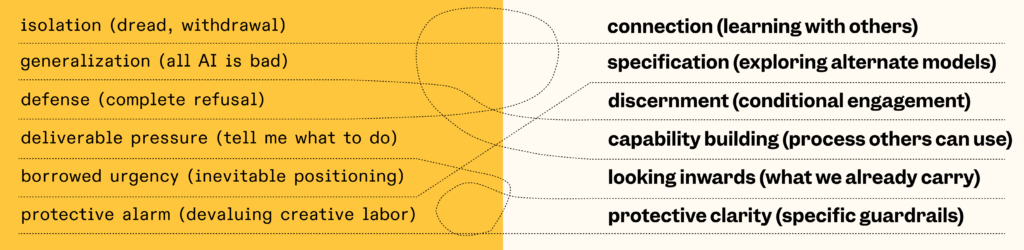
Everyone’s busy, and insight fades if nobody documents it. So we added a recurring piece to the process: after every couple of deep dives, we now dedicate a session to reflecting, iterating on our internal guiding document, and harvesting where each person’s thinking has actually moved. We’ll do this at least twice more before the year is out, and each round produces a public reflection like this one.
For this first harvest, we gave everyone the same set of prompts and wove their answers together. We’ve kept them largely unedited–an honest picture of people thinking through the same hard thing from genuinely different starting points:
Rachel’s Reflections:
When Educopia named AI as the next layer of our work, I came in feeling apprehensive and resistant.
We started with research sprints, digging into one dimension of the landscape. Mine was What are our communities already encountering? and the thing that surprised me most was that although many organizational leaders are hostile and dismissive of critiques of AI, there are alternative, thoughtful ways to view AI critiques and refusals. For example: Carole McGranahan argues in “Theorizing Refusal: An Introduction” (2016) that “[t]o refuse can be generative and strategic, a deliberate move toward one thing, belief, practice, or community and away from another. Refusals illuminate limits and possibilities, especially but not only of the state and other institutions.” Such a politics of refusal, embedded in the fields of critical and feminist data studies, can be a source for imagining new possibilities, while being informed about the material conditions that underlie and shape technologies and technological use (D’Ignazio, 2022; Garcia et al., 2022; Zong & Matias, 2024).
Then we refined our question bank—sorting what we can already speak to from what we still need to answer ourselves. The question I most want us to get right is how we can participate in refusals and critical approaches to AI that, as McGranahan puts it, are a “source for imagining new possibilities, while being informed about the material conditions that underlie and shape technologies and technological use”?
Lately we’ve been doing deep dives, starting with Governance and Funding. The idea that’s stuck with me is the pace of change makes most guidance resources stale on arrival: given the rate at which the AI technologies are developing, practical guides pinned to specific tools or current policy language tend to be outdated by the time they’re published. Thus we need to find ways to be useful to our constituencies without claiming to be able to know everything that is happening or will happen.
The biggest shift in my thinking across all of this has been from dread and despair to eagerness to learn from the amazing work and thinking others are doing around ethical approaches to generative AI. If another small, community-serving organization is just starting to wonder how to approach AI at all, the one thing I’d want them to hear from us is that we value human creativity and intelligence over artificial intelligence and that our uses of AI are deliberate and informed by environmental and ethical concerns.
Jessica’s Reflections:
When Educopia named AI as the next layer of our work, I came in feeling eager to know more, aware of my lack of knowledge, knowing this is being sold to all of us as inevitable, as a user of chatbots seeing more and more news about harms.
We started with research sprints, digging into one dimension of the landscape. Mine was transitions, and the thing that surprised me most was the key concept that emerged: “infrastructure legibility” — whether a community can actually understand, govern, and if necessary exit the tools they’re relying on.
Lately we’ve been doing deep dives, starting with Governance and Funding. The idea that’s stuck with me is that Educopia staff have direct impact on these decisions whereas others in larger organizations do not – and given that we work for folks that are located in bigger organizations, it helps us to sharpen where we can support and intervene in that space without undermining existing structures.
The biggest shift in my thinking across all of this has been from trying to build shared understanding based on reviewing resources OUT THERE to grounding in Educopia – and examining these topics through the lens of what is already in place wherever we can – really grounding the series in Educopia.
What’s been genuinely useful about learning this way—slowly, together, as paid work—is we don’t foreclose what can come up here – just in the sessions so far we have generated project ideas, a guiding document, more questions, and a replicable process. If we would have just said, okay “let’s draft a document and then do a feedback round till we have a workable version 1” I would not be learning from my colleagues and their work, and we wouldn’t have the space for things to emerge.
If another small, community-serving organization is just starting to wonder how to approach AI at all, the one thing I’d want them to hear from us is about our process of learning – starting with what we are already carrying. A tempting move is to start looking “out there” but if you start “in here” there is already so much richness that will guide a process with a much more meaningful outcome.
Jackson’s Reflections:
When Educopia named AI as the next layer of our work, I came in feeling some level of AI fatigue/pressure to come to a productive or actionable solution (with the concern that we might not have enough space to actually map out the problem space first).
We started with research sprints, digging into one dimension of the landscape. Mine was governance, and the thing that surprised me most was the silos around governance that exist – governance around data (storage/determining whether a community’s data is used to train AI models), AI tool usage, and AI development were all very separate, and different communities had done more work with different aspects but they weren’t in dialogue (i.e. corporations worrying about AI tool usage and liability for results vs. communities being concerned about retaining control over their data).
Then we refined our question bank—sorting what we can already speak to from what we still need to answer ourselves. The question I most want us to get right is what level of scaffolding is needed to support a community to make an informed decision about AI – and what expertise can be responsibly outsourced to a trusted external partner/collaborator? Some of this scaffolding could be around AI literacy but it would also be about governance or other aspects of technology.
Lately we’ve been doing deep dives, starting with Governance and Funding. The idea that’s stuck with me is how to articulate the value of what we do, since so much of what we excel at (synthesis, facilitation, zooming in and out, systems mapping, etc.) is often invisible or not understood well within our field, and thus potentially more likely to be thought of as something that can be pawned off to AI.
The biggest shift in my thinking across all of this has been from hypothetical to concrete – not only thinking about what is currently already happening in the field, but what real unmet needs we’ve encountered that we want to be more active in addressing.
What’s been genuinely useful about learning this way—slowly, together, as paid work—is creating space for shared learning is very valuable because it helps us understand each other’s thinking, values, and ways of working that make it easier to feel like there’s enough space for everyone’s full perspectives, rather than starting with a reactionary or defensive posture that can come with the pressure for certain types of immediate outcomes.
If another small, community-serving organization is just starting to wonder how to approach AI at all, the one thing I’d want them to hear from us is starting from where you have expertise and then mapping out what you want to learn internally and what you want to learn with trusted partners (the format of the question bank).
Racquel’s Reflections:
Integrating all 3 segments in service both closure on what you all did today – and also a chance to refine any of your previous responses
When Educopia named AI as the next layer of our work, I came in feeling fairly neutral. I saw it as something that was becoming part of the landscape and worth understanding.
We started with research sprints, digging into one dimension of the landscape. Mine was privacy, HR considerations and financial implications, and the thing that surprised me most was how many operational questions sit just beneath the surface of everyday AI use.
Then we refined our question bank—sorting what we can already speak to from what we still need to answer ourselves. The question I most want us to get right is when is it the right for implementation, and how to use AI responsibly while protecting data. Lately we’ve been doing deep dives, starting with Governance and Funding. The idea that’s stuck with me is clear governance matters more than the specific tool we’re using.
The biggest shift in my thinking across all of this has been from seeing AI as primarily a technology conversation to seeing it as an operational conversation that touches finance, HR and organizational risk.
What’s been genuinely useful about learning this way—slowly, together, as paid work—is the space to understand before making assumptions about how AI should fit into our work.
If another small, community-serving organization is just starting to wonder how to approach AI at all, the one thing I’d want them to hear from us is AI is here, so it’s worth taking the time to understand it and decide intentionally how it fits within our mission and values.
Eric’s Reflections:
When Educopia named AI as the next layer of our work, I came in feeling disheartened.
We started with research sprints, digging into one dimension of the landscape. Mine was Red-Teaming Our Own Assumptions with Racquel, and the thing that surprised me most was that Racquel and I were more aligned in our views on A.I. than I had previously thought.
Then we refined our question bank—sorting what we can already speak to from what we still need to answer ourselves. The question I most want us to get right is “why should we use A.I.?”
Lately we’ve been doing deep dives, starting with Governance and Funding. The idea that’s stuck with me is that the general feeling within Educopia seems to be that A.I. use is inevitable (a notion I disagree with).
The biggest shift in my thinking across all of this has been from complete aversion to A.I. to possibly accepting the use of contained Small Language Models outside the purview of the major A.I. companies.
What’s been genuinely useful about learning this way—slowly, together, as paid work—is getting a good idea of the variety of opinions people at Educopia have (always good to make sure you are avoiding an echo chamber).
If another small, community-serving organization is just starting to wonder how to approach AI at all, the one thing I’d want them to hear from us is to take it slow and consider all of the potential benefits, pitfalls, and ethical/moral ramifications of A.I. use.
Katherine’s Reflections:
When Educopia named AI as the next layer of our work, I came in feeling ambivalent.
We started with research sprints, digging into one dimension of the landscape. Mine was the funding landscape, and the thing that surprised me most was the focus on theory – though I wasn’t looking at resources targeted towards grantees around what AI might mean for sustainability or efficiencies.
Then we refined our question bank—sorting what we can already speak to from what we still need to answer ourselves. The question I most want us to get right is understanding funders’ assumptions about use and challenging this assumption that AI-usage is so efficient.
Lately we’ve been doing deep dives, starting with Governance and Funding. The idea that’s stuck with me is trying to get a better understanding where AI has already been built into systems so I can be better informed (e.g., I am guilty of skimming through terms of use pages from platforms and I don’t include personal information in chat-bot responses, but I have not necessarily thought too deeply about what I write in them and where it’s going).
The biggest shift in my thinking across all of this has been from lumping together everything that might constitute AI to thinking about our usage of LLMs. What’s been genuinely useful about learning this way—slowly, together, as paid work—is what kinds of guidelines exist out there as framing for what I think we should (and/or don’t need to) address in policy.
If another small, community-serving organization is just starting to wonder how to approach AI at all, the one thing I’d want them to hear from us is around exploring and having fruitful conversations about AI – e.g., clarifying what they mean when they say AI, how they’re actually using AI, what expectations are around usage, practices in terms of how to keep up to date.
Aloma’s Reflections:
When Educopia named AI as the next layer of our work, I came in feeling protective alarm about what it could mean for creative labor, especially the kind of interpretive, contextual work our communities depend on and rarely get paid fairly for as it is.
We started with research sprints, digging into one dimension of the landscape. Mine was What are our communities already encountering?, and the thing that surprised me most was that the real dividing line isn’t between organizations that use AI tools and those that don’t, but rather between organizations that treat creative and curatorial labor as a cost to be minimized and organizations that treat it as the actual mechanism through which trust and identity gets built with a community.
Then we refined our question bank, sorting what we can already speak to from what we still need to answer ourselves. The question I most want us to get right is not whether a tool touches creative work, but which part of the work it touches: does it sit where meaning is actually made (interpretation, framing, relationship, aesthetic judgment), or only where meaning has already been made and now needs to be reproduced (formatting, transcription, resizing)?
Lately we’ve been doing deep dives, starting with Governance and Funding. The idea that’s stuck with me is the amount of AI slop that is being generated on the daily, especially when folks aren’t fully cognizant of a tool’s actual capability, and how actually experimenting with said tools (+ following along others’ experiments) reveals some hard truths about the current reality of the usefulness and trustworthiness of AI tools (like LLMs) vs. the use cases being marketed to us. Also illuminating: the alternatives and trade-offs that are out there!
The biggest shift in my thinking across all of this has been from protective alarm, treating any intersection of AI and labor as a threat, to protective clarity: exploring articulating specific criteria for telling when a tool is actually supporting that labor.
If another small, community-serving organization is just starting to wonder how to approach AI at all, the one thing I’d want them to hear from us is: don’t start by asking whether to use AI on a piece of creative or curatorial work. Start by asking where the value in that work actually lives, then build your policy around protecting that part specifically.
Where this sits in a bigger conversation:
We didn’t start this Lab to answer “is AI good or bad?” We’re approaching it with nuance: given the specific pressure our community is under, and the principles we’re committed to, what do we actually do about this particular thing?
We’re also not doing this in a vacuum. Researchers like Timnit Gebru have spent years pushing back on who controls AI development, and arguing for targeted, purpose-built tools over sprawling general-purpose systems. Projects like the Public Interest Corpus are building community-governed AI training data out of library and archive collections. University teams, Penn State’s Liberatory Tech Project among them, are showing what humanities-driven, culturally grounded AI development can look like. And inside the biggest AI companies, engineers themselves are describing an industry moving faster than its own guardrails.
This work also runs through everything else Educopia is doing this year. It touches our community infrastructure work, helping communities exit dependency on corporate platforms. It touches our field practice work, building transition packages for organizations under strain. It touches questions about ethical leadership in knowledge institutions right now, and our shared tools work on governance. AI shows up as a condition running underneath all of that, not as a separate item sitting off to the side of it.
If you’re facing this pressure too:
If your organization is being pushed to produce an AI strategy, policy, or public position, a New Work Lab is one alternative to the two paths usually on offer: chase internal consensus until everyone’s worn out, or someone from the outside hands you a position you didn’t actually build together.
A process like this involves your full team, not just leadership or whoever’s closest to the technology, and it produces two things at once: real internal clarity about what you actually believe, and language you can bring externally, to funders, partners, and your own communities, that’s honest about what you know and what you’re still working out. No more decoys.
We’ll be back with the next harvest after our upcoming deep dives. In the meantime, if you’re a peer organization thinking about running something similar, or a funder curious about what it would take to support this kind of structured learning at scale, we’d genuinely like to talk! Please reach out to jessica@educopia.org