

The Project
From April to September 2023, Educopia was employed to facilitate a deliberate, member-driven process to reimagine the broad suite of CRL global collections activities. Using the Community Cultivation Framework, the Educopia team undertook a series of “Transition” lifecycle activities designed to help CRL’s global collections activities to:
- assess landscape changes and member needs in reference to the CRL International Collections and Content Group (ICCG) Call to Action,
- evaluate current program activities to identify gaps and opportunities,
- and revisit and update the current scope and impact of the global collections programs.
The Outcome
Building on the work of the CRL Board, CRL’s Collections and Services Policy Committee (CSPC), ICCG, and CRL Staff, Educopia led a concrete, community-driven recalibration of CRL’s global collections activities (a plurality of overlapping and interdependent functions, activities, and relationships). Using a diverse set of approaches including surveys, interviews, full-community convenings, and work sprints, we navigated multiple phases to arrive at a:
- clear scope and value proposition for CRL’s global collections programs, as well as an Impact Model
- coherent Vision for Change
- Implementation Plan with benchmarks and milestones
Important reference documents include: Community Convening #1, Community Convening #2, and the resultant Impact Model.
Project Background
The engagement with Educopia draws on the longstanding work of the CRL community – in 2020, the CRL Collections and Services Policy Committee (CSPC) survey made clear that CRL members place CRL’s global collections at the top of their expressed priorities. In 2021, the CRL International Collection Content Group’s (ICCG) Call to Action reaffirmed the community’s commitment to global collections, programming, and services. More contextual information can be found on CRL’s webpage for strengthening global collections.
What We Learned
Strengthening CRL Global Collections Community Convening (Phase 1: Discovery)
The Phase 1 Discovery period involved communicating with key CRL stakeholders from across the system, including board members, external affiliates, committee and working group members, staff, and members of communities of interest. The Educopia project leads Jessica Meyerson and Katherine Kim conducted 7 focus groups and 9 interviews, involving 41 participants total. These conversations addressed the positioning of global collections within CRL’s mission and priorities, the trends accelerating or amplifying challenges and opportunities in the field, the information or data that could be used to inform collective collecting priorities, and leadership proficiencies and characteristics for strengthening global collections.
The first Community Convening that Educopia facilitated provided an opportunity for the community to debrief on findings from Phase 1 (Discovery). Educopia project leads facilitated community conversation and shared their analysis of data collected through a robust series of focus groups and targeted interviews. This community-wide call was aimed at the following objectives:
- Clarify the current scope of current CRL global collections activities
- Identify key challenges as well as associated opportunities (e.g., programmatic and administrative) for CRL global collections moving forward
- Share emerging visions for change
- Elicit community feedback regarding findings from Phase 1
- Describe how these findings will inform Phase 2 (Impact Modeling)
View the event recording of the community convening.
Major areas of the presentation included establishing a shared understanding around positioning global collections activities within CRL’s core functions and strategic priorities, naming CRL as a backbone organization, and considering CRL’s global collections within a broader system. Educopia consultants highlighted three primary system components: governance and decision making; administrative and operational infrastructure; and models of collective collecting.
Strengthening CRL Global Collections Community Convening (Phases 2 & 3: Impact and Sustainability Models)
In this second Community Convening, Educopia project leads introduced Impact and Sustainability sprint team members to discuss work accomplished through the summer. This community-wide convening accomplished the following objectives:
- Discuss the process to develop the Impact Model and the work this model does in support of the larger process;
- Define sustainability and discuss the sustainability sprint team’s work;
- Share comprehensive models that address mission alignment, fiscal management, and governance for CRL global collections;
- Elicit community feedback regarding findings from Phases 2 and 3; and
- Review the timeline and next steps to implement the proposed structures.
View the event recording of the community convening.
Our Takeaways
A major aspect of this engagement included the creation of an Impact Model. Multi-stakeholder participation and representation in the group that created the draft model was critical to ensuring that the resulting model and the communications to the CRL community would address the interests and needs of all stakeholder groups. The collective focus of this group was to define strategies and activities that move CRL from its current situation to its desired impact. The Impact Model serves as a representation of how CRL global activities are supposed to work, providing a common language and a point of reference for all stakeholders.The Impact Model articulated the issues CRL global collections activities are trying to address at two levels:
- Field Level
Transition to postcolonial frame for collective global collections activities; Institutions’ competing collecting priorities, and thematic collective collecting can only be accomplished at the field level; Need for a trusted organization to hold space for relationship networks with librarians and knowledge producers in other countries (that need to be nurtured over the long-term; Lack of staff capacity and resources for area studies, non-English language specializations, diminished investments in skills and competencies, etc. within individual member institutions - Organization Level
The number and scale of CRL global collections activities have outgrown current infrastructures processes, and staff capacity; Current misalignment between what we need the CRL global collections governance to enable and the structures and processes currently in place to meet them; No clear articulation of the types of information inputs needed to feed into and out of the CRL global collections system in order to support governance in making strategic decisions.
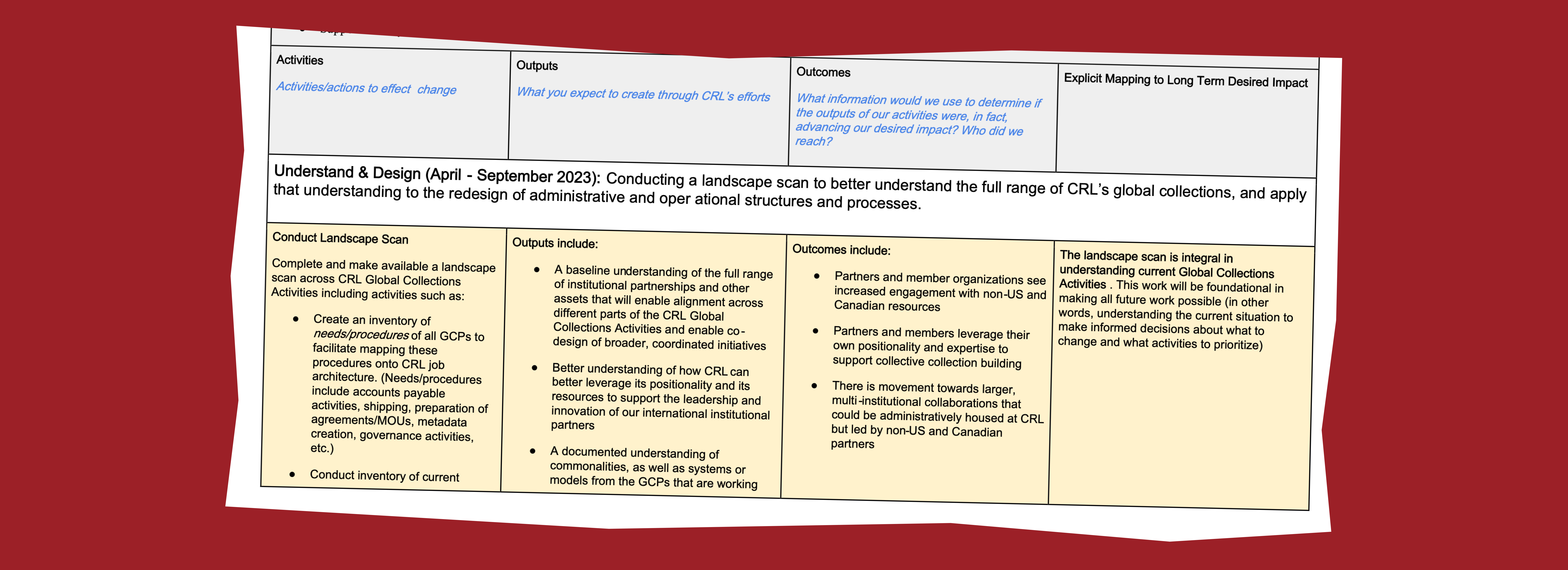
The Impact Model outlines Resources (what CRL brings to address the situation) and Long-term Impact (the effects CRL will have on the situation or problem over time). It then details CRL’s strategy across Activities (actions to effect change), Outputs (the expected results of CRL’s efforts), Outcomes (the information used to determine if the outputs are advancing our desired impact), and an explicit mapping to Long-term Desired Impact, organized into the following phases:
- Understand & Design (April – September 2023): Conducting a landscape scan to better understand the full range of CRL’s global collections, and apply that understanding to the redesign of administrative and operational structures and processes.
- Invest, Implement, & Improve (October 2023 – April 2024): CRL enters an implementation phase for new administrative, operational, and governance processes created in the “Understand & Design”phase; Investments will be made to improve technological infrastructure
- Assess & Expand (April – 2025 and beyond): Facilitating culture change, communicating impact and accountability measures, and continuing to build trust and foster relationships.
“This engagement preceded the thoughtful work of CRL committees, staff, leadership, and groups, and was followed by CRL’s work in building a shared collection model that is sustainable, leverages the organization’s unique strengths, and aligns to its mission, collections, and services model for institutional members. It was rewarding to work with so many of CRL’s constituents, and the process highlighted the ways in which change is both challenging and necessary.”
— Katherine Kim, Co-Executive Director, Educopia